
Nation’s Diversity a Key Part of the Story
Wilbon Taking Leave From ‘Pardon the Interruption’
Two Reactions to Story on Kidnapped Cuban Journo
Homepage photo credit: MS NOW
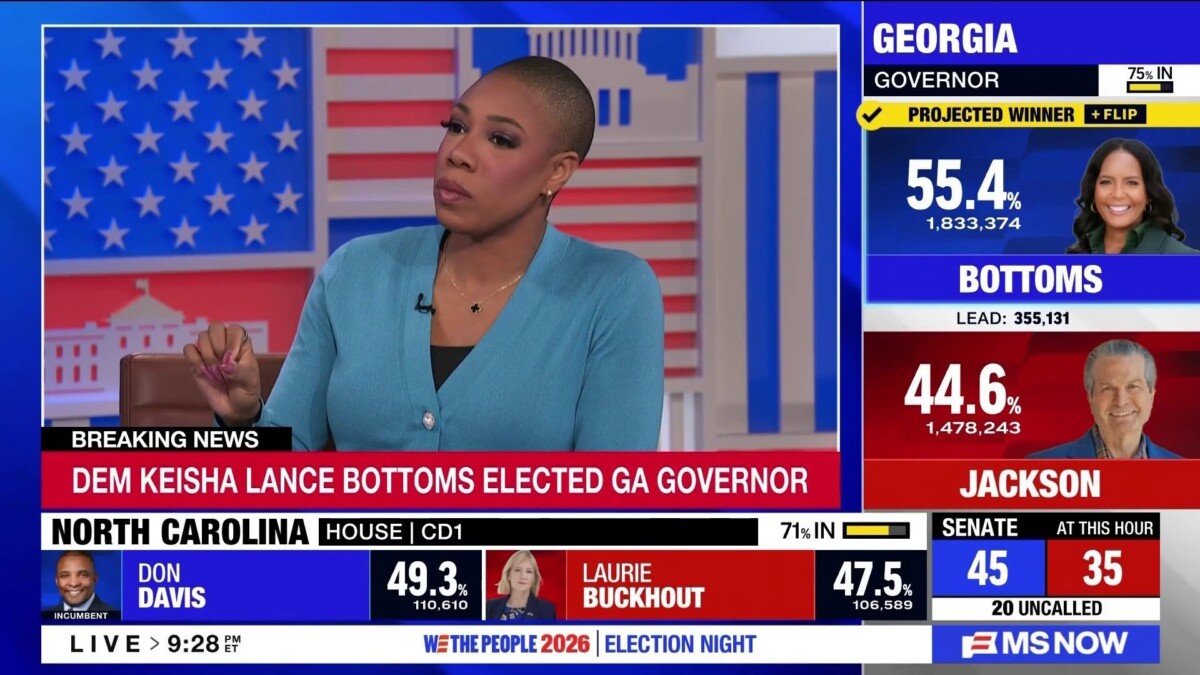
“To the black women who thought, after 2024, that America didn’t want us… Georgia wanted Keisha.”
Symone Sanders gets emotional after Keisha Lance Bottoms is announced next Georgia’s Governor 😢🥲🥲 #Elections2026 #BlueWave #MSNOWNEWS https://t.co/7fXcUszSUl
— Dustin Cone (@Dustin_Cone) November 4, 2026
If no image is visible, please consider changing browsers.
Nation’s Diversity a Key Part of the Story
It was a TV moment.
“I’m over here about to cry, Lord,” replied Symone Sanders Townsend on election night, after MS NOW declared Keisha Lance Bottoms, another Black woman, winner of the Georgia gubernatorial race. It was 9:28 p.m. Eastern time. Fellow panelist Lawrence O’Donnell asked how Sanders Townsend felt.
“After the 2024 presidential election, [for] Black women all over this country, it felt like a repudiation of us,” Sanders Townsend continued. “The fact that in North Carolina, for example, in 2024, every Democrat that was on the ballot statewide won, except Kamala Harris. I’m like, ‘well, what is this?’
“So there were Black women, myself included, that felt like, well, maybe America just does not want us. And Keisha Lance Bottoms went out there, and to be clear, when she first was on the campaign trail, she went out there in some box braids this summer. And I was like, look at the mayor in her box braids. I don’t know if this is gonna help us win it. And she has won.
“She won going out there, being herself, talking about the issues, connecting with the people, and, you know, for the 92% out there that was feeling like, ‘oh, maybe this, maybe the country just doesn’t want us.’ Georgia wanted Keisha.”
Television sisters Rachel Maddow and Nicolle Wallace reached across the table to comfort her.
Over on ABC, Steve Osunsami, another Black journalist, likewise told anchor David Muir, “I don’t think it can be overstated what has happened here in Georgia. . . . . It’s hard for me to accept this is a blue state.”
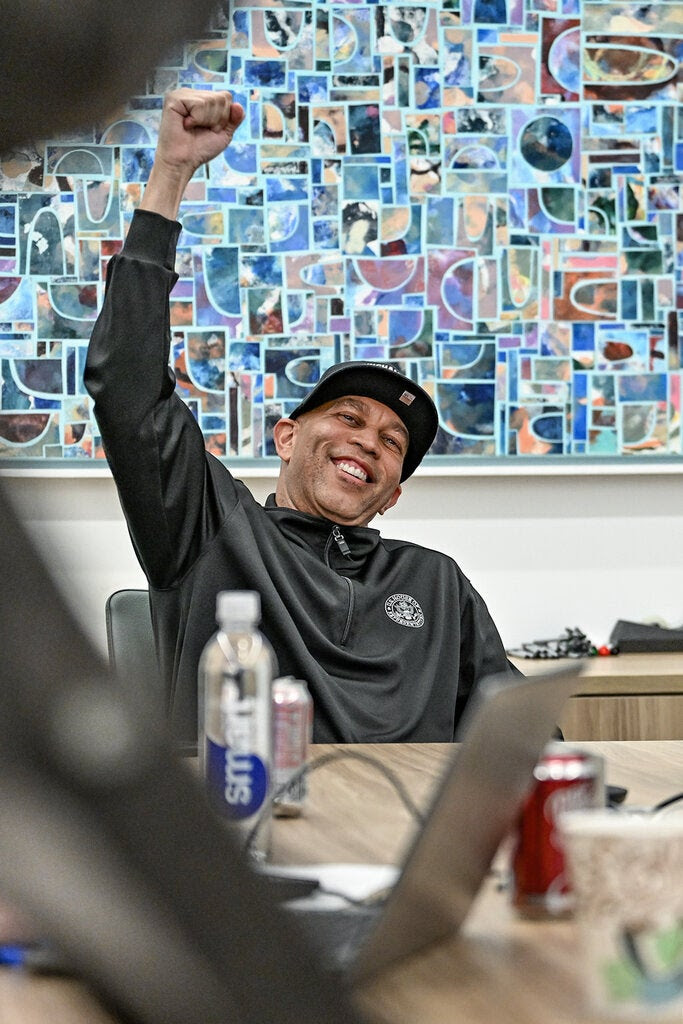
Hakeem Jeffries, D-N.Y., the likely next speaker of the House, celebrates Tuesday’s Democratic victories. (Credit: Kenny Holston/New York Times)
On CNN, Van Jones, also a Black commentator, declared of the Republicans and their fealty to President Donald Trump:
“They have candidates who are dropping like flies because they did not stand up to this guy when he was doing things that were wrong, when he was violating the law, when he was running over our system,” reported for HuffPost.
“ ‘They didn’t stand up to him, and they’re paying the price. It’s Jonestown tonight. You join a cult, at some point you go to Jonestown,’ Jones continued, referring to the 1978 mass murder-suicide of more than 900 Peoples Temple members in Guyana. ‘That’s where you are tonight, Republicans.’ ”
There was joy in the house. MS NOW became a ratings winner when it staged election night watch parties for members in two states at the center of the Democratic surge. Reporter Antonia Hylton broadcast from The Painted Pin in Atlanta, while Alicia Menendez reported from Houston’s Rooftop Cinema Club, where members gathered to follow the results. The Latino voters in attendance could not contain themselves. They had helped elect a Hispanic governor in Texas.
The news media were quick to note the historic nature of the midterm elections that ended Tuesday night — not only for the massive “blue wave” and repudiation of President Trump and the Republicans, but for what they said about how the natin’s diversity was playing out.
“Yes, the 2026 midterms will be remembered for the astonishing number of losses that Democrats handed to President Donald Trump,” Terry Tang wrote for the Associated Press. “But in the background, something perhaps equally seismic unfolded: a wave of firsts that elevated into high office members of groups that had, until now, been kept largely at the margins.
“There were cheers and happy tears at election parties from New Mexico to Georgia late Tuesday once it became clear voters had elected the country’s first Black female governor, the first Native American female governor, the first Native female senator and the first openly gay male U.S. senator. By early Wednesday, the first Muslim U.S. senator was also added to the list of barrier-breaking milestones. The astonishing blue wave also means the United States will likely have its first-ever Black speaker of the House.
“Most of these firsts are Democrats, but the GOP has also broken some new ground,” most notably with the election of Rep. Byron Donalds, R-Fla., as nation’s first Black Republican governor.
Moreover, “Latinos, both Democrats, will take on the highest state office in two of the biggest states. Texas voters rejected Gov. Greg Abbott in favor of Gina Hinojosa, who will be the state’s first Latina governor. Xavier Becerra, former California attorney general, outpaced Republican Steve Hilton. He will be California’s first Latino governor since Romualdo Pacheco in 1875.”
(Credit: YouTube)
In addition, as Shefali Luthra and, Grace Panetta pointed out for the 19th, the victory of Illinois Lt. Gov. Juliana Stratton “makes her the fifth Black woman ever elected to the U.S. Senate and cements Illinois as the first state to have two women of color in the Senate at the same time. [Sen. Tammy Duckworth’s father was a white American, and her mother is Thai of Chinese descent.] Her win also guarantees that, for the first time in history, three Black women will serve simultaneously in the upper chamber.”
In these days of an ever-expanding definition of “media,” it would be a mistake to limit the term as narrowly as we did when print and broadcast were the only options.
“Rashida Jones, who serves as chief executive of Piers Morgan’s media company Uncensored, predicted that Tuesday’s midterms will come to be remembered as ‘the content creator election’, when independent journalists hosting streaming broadcasts give traditional networks a run for their money,” Jeremy Barr reported for the Guardian.
“Jones was running one of those television networks, MSNBC (now called MS Now), during the 2024 presidential election, a role she held for four years. She is working to expand Morgan’s company by launching new shows and verticals beyond the ‘Piers Morgan Uncensored’ streaming broadcast, which has about 4.5 million subscribers on YouTube.”
And so news consumers additionally had access to such journalists as Jim Acosta, Joy Reid, Roland Martin and Don Lemon covering the election via YouTube, Substack or social media. Not only did these hosts feel free from the control of mainstream media bosses, but also from language restraints.
Referring to Trump and the victorious Michigan U.S. Senate candidate Abdul El-Said, Lemon said, “I have a feeling that Abdul El-Said is going to eat his f—ing lunch.” One of his guests said of the failed Ohio Republican gubernatorial candidate, “Vivek Ramaswamy is a piece of s–t,” and continued in kind.
Less encumbered or not, though, these outlets cannot compete with the traditional media in resources.
Se vienen cambios muy importantes en Estados
Unidos.
-Gina Hinojosa fue elegida gobernadora de Texas, convirtiéndose en la primera mujer latina en ocupar ese cargo en la historia del estado.
-Xavier Becerra fue elegido gobernador de California, convirtiéndose en el primer latino elegido democráticamente para gobernar ese estado.
-Ambos son estadounidenses de ascendencia mexicana.
-Deb Haaland ha ganado la elección para gobernador de Nuevo México, derrotando al republicano Greggory Hull. Se convierte oficialmente en la primera mujer nativa americana elegida gobernadora en la historia de Estados Unidos.
— Cerebros (@CerebrosG) November 4, 2026
The New York Times produced an interactive map on “How Americans Voted in the 2026 Election by Race, Gender, Age and Education.”
The Atlanta Journal-Constitution produced a 2,000-word piece on Bottoms by reporter Ernie Suggs. It began:
“His value was placed at $1,400.
“On another surviving document, Sheppard signed his name with an X.
“More than a century and a half later, Sheppard’s great-great-granddaughter, Keisha Lance Bottoms, was elected governor of Georgia.
“Across 250 years of American history, only three Black Americans had ever been elected governor of a state.
“Three men. Three states. Across nearly 2½ centuries.
“Now Bottoms has joined that extraordinarily small group, along with Republican Byron Donalds, who won Tuesday’s election for Florida governor, and Democrat David Crowley, who won the race for Wisconsin governor.
“But she is the first Black woman to do so. . . .”
Other pieces of the diversity story involved the shift in the Latino vote, the election of Native Americans and the success of El-Sayed.
The Detroit Free Press portrayed the latter as a positive for the country, “In a nation that prides itself on its diversity but often falls short in giving voice to those in minority communities, Abdul El-Sayed’s win in the race for Michigan’s open U.S. Senate seat stands as a mark of how inclusive and expansive American democracy – and its electorate – can and will be, given time and opportunity,” wrote Todd Spangler and Dana Afana.
On NPR’s “Morning Edition” on Wednesday, David Martin Davies, Texas Public Radio reporter and talk show host, and political consultant Mike Madrid gave host Steve Inskeep their explanations for the shifts in the Latino vote.
“Latinos are really kind of the last swing voter,” Madrid said. “What David Martin Davies just pointed out was a 35 point swing following a 20 point swing just two years ago for the exact same reason, which is again, a failing focus from parties, either parties, from administration from both parties to focus on blue collar working class economic issues.
“Neither party is addressing those concerns in any meaningful way, and neither party is certainly getting the results. So until that happens, we’re going to continue to see this emergent Latino populism is really what it is. It’s dealignment, a movement away from both parties. And it’s fascinating to watch unfold because Latinos are the most independent-minded, least partisan voters in America. They’re demonstrating that at the ballot box. And in many ways, Steve, it’s important to look at it as voters doing what the founders intended, which is if somebody’s not doing their job and prioritizing the work they said they would do, you fire them.”
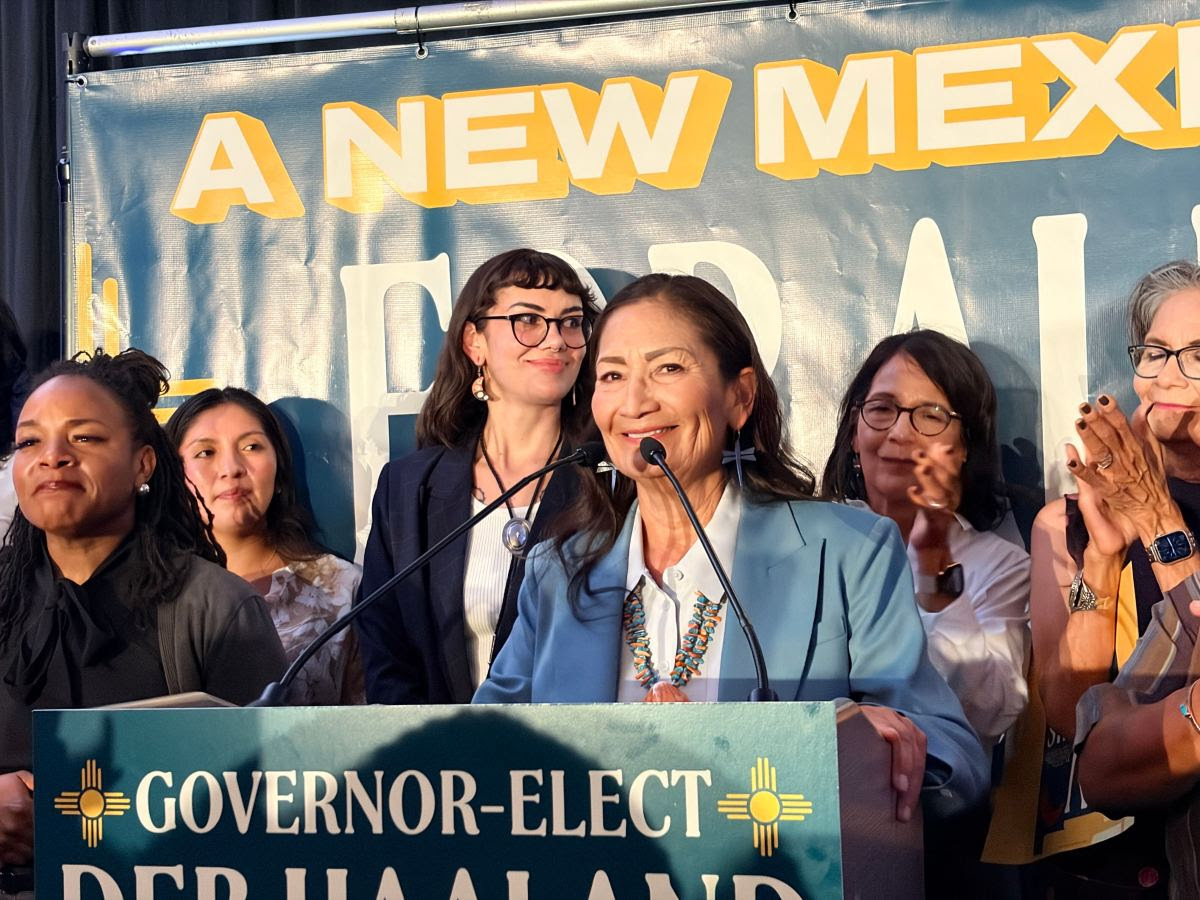
ICT, formerly Indian Country Today, reported on Deb Haaland, Laguna Pueblo, speaking at a watch party with her daughter, Somah Haaland, behind her at the Pueblo of Laguna’s Route 66 Casino west of Albuquerque, N.M., on Tuesday. Haaland was elected the nation’s first Native American woman governor. (Credit: Pauly Denetclaw/ICT)
For indianz.com, Acee Agoyo wrote that “Native women made history on election day in 2026,” including Peggy Flanagan, a citizen of the White Earth Nation, who won election to the U.S. Senate in Minnesota with nearly 54 percent of the vote, according to unofficial results, and Democratic candidate Mary Peltola, who is Yup’ik from Alaska, poised to become the second Native woman to join the Senate.
Although Donalds won election as the nation’s first Black Republican governor, he did so without much Black support, according to the Miami Herald.
“When it comes to Miami-Dade’s 124 majority Black neighborhoods, Donalds didn’t come close to the Democrats,” Shirsho Dasgupta, Ana Claudia Chacin and Olivia Lloyd reported on election night. His Democratic opponent, Tom Jolly, “won those precincts by about 70 percentage points.
One unknown is the effect of the election on the news media.
Media critic Eric Deggans wrote Tuesday on Substack, “My sense, in speaking to average media consumers in recent months, is that people are really concerned about the fate of a free press in America and not particularly eager to see the White House trying to intimidate journalists.
“With Democrats in control of Congress, it may be tougher for the administration to send the Federal Communications Commission after media outlets the president doesn’t like, or for regulatory agencies to approve mergers aimed at helping Trump allies.
“Of course, Trump being Trump, he may just double down on his strategy of demonizing the press to galvanize his base. But I’m hopeful this election result was a vote for stability and a demand for institutions to serve the American people rather than the president’s allies and family. Which provides an opening for quality journalism to prove its value to the public.”
The Journal-isms Roundtable plans to discuss this at its next session this coming Sunday; details to be announced.
- Jem Bartholomew, Columbia Journalism Review: ‘Let’s Get Rid of Her’: Voters may punish Donald Trump at the polls this week. But he has already shattered the norms of political journalism.
- Danielle Belton, URL Media: On Election Night, Americans hit the brakes on Trump. Hard.
- Jamelle Bouie, New York Times: Trump Has Been Thumped. That Doesn’t Make Him Any Less Dangerous
- Mary C. Curtis, Roll Call: Lindsey Graham’s famous quote makes sense now
- Editorial, San Antonio Express-News: A historic night in Texas as Democrats Gina Hinojosa and James Talarico win
- Lucas Finton, Annie Goldman and Jack Armstrong, Commercial Appeal, Memphis: TN District 9: Brent Taylor seems to have narrowly beaten Justin J. Pearson
- Gerren Keith Gaynor, theGrio: Abdul El-Sayed makes history as first Muslim elected to U.S. Senate in Michigan
- Gerren Keith Gaynor, theGrio: Trump threatens veto power after Black voters help deliver major losses to Republicans
- Michael M. Grynbaum and John Koblin, New York Times: Candy and Smiles on MS NOW, and Some Regrets on Fox News
- Joint Center for Political and Economic Studies: Black Representation in the 2026 Midterm Elections
- Stephanie Kaloi, Mediaite: Mississippi Senate Race Takes Absolutely Stunning Turn — As Republican Goes from 96% Prediction Market Favorite to Underdog in a Flash
- Ariama C. Long, Amsterdam News, New York: NYS elects women leaders, first Black woman Lt. Governor; Jeffries poised to become House Speaker
- Garry Pierre-Pierre, URL Media: Around the world, voters are rejecting their leaders. But what comes next?
Lydia Polgreen, New York Times: America has elected its first Muslim senator. It was a long road getting here.
- Christopher Rhodes, Blavity: James Talarico Ends A 32-Year Democratic Drought In Texas After One Of The Most-Watched, Most Expensive Campaigns Ever
- Christopher Rhodes, Blavity: How Keisha Lance Bottoms Won Georgia: A Final Push From Heavy Hitters And A Historic Result
- Christopher Wiggins, the Advocate: Senator-elect Chris Pappas celebrates historic New Hampshire win beside his husband: ‘I’m the luckiest guy
https://t.co/RkkZiNSxvx
— Michael Wilbon (@RealMikeWilbon) November 2, 2026
If no image is visible, please consider changing browsers.
Wilbon Taking Leave From ‘Pardon the Interruption’
“True to his billing as a legendary sportswriter, Michael Wilbon used a sports reference to describe why he is taking an indefinite leave of absence from ESPN and his show ”‘Pardon the Interruption,’ which he has co-hosted for 25 years alongside his former Washington Post colleague Tony Kornheiser,” Chris Bumbaca reported Monday for USA Today.
“ ‘This isn’t a retirement,’ Wilbon wrote in a statement posted on social media, ‘but it is a trip to the injured list. Hopefully not an extended one.
“ ‘Struggles with multiple health issues in recent months lead me to take an indefinite leave of absence from my ‘PTI’ and NBA duties at ESPN and ABC.’
“Wilbon said he should have listened to medical professionals and friends such as Kornheiser sooner because they ‘saw worrisome signs in recent years that suggested I take time away earlier. But I didn’t.’ . . . .”
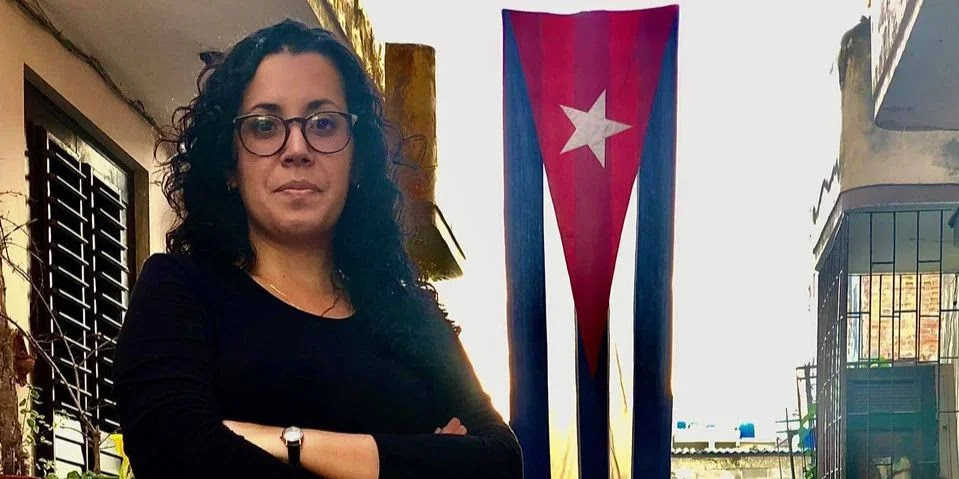
Camila Acosta (Photo taken from her Facebook profile)
Two Reactions to Story on Kidnapped Cuban Journo
After sharing this story Tuesday from Cuba, “State security forces kidnap journalist Camila Acosta,” two journalists, one American, the other Cuban, reacted.
The story, from CubaNet, a Miami-based outlet produced by Cuban journalists in exile, began:
“CubaNet journalist Camila Acosta was arrested on Tuesday, November 3, on the public road, in the Havana municipality of Plaza de la Revolución, when she was going with her pet to the veterinarian, according to her husband, the writer and former political prisoner Ángel Santiesteban.
“Santiesteban explained that he received the notice from a neighbor who witnessed the arrest and rescued the journalist’s cat, which had been left on the street. ‘They took her in handcuffs and violently put her in the patrol car,’ the writer said.
“According to the information he received, other neighbors interceded with the police and expressed their disagreement with the arrest. ‘They said that Camila was a decent person but they replied that because of her they had beaten a revolutionary’s relative. We don’t know what they’re accusing her of,’ Santiesteban added.
“At the time of publishing this information, the place to which the reporter had been transferred was unknown. . . . .”
* * *
The American journalist wrote, “This is alarming. I’m still baffled by the relative lack of national coverage…. especially by the major dailies and wire services.
“Curious if the journalism associations (nahj etc) have weighed in on these issues? . . . ”
The Cuban journalist, Julio Antonio Rojas, an Afro-Cuban and a correspondent for Journal-isms who is a native of the island, replied, “It may be, sir, that some of these media outlets have no interest in these alarming reports about the repression on the island. Yet, making this information known should be the top priority. We journalists on the island face the risk of enforced disappearance — all the more so given the talk of war and the fear gripping the regime; we are the regime’s number-one enemy.”
The story continued:
“At the time of publishing this information, the place to which the reporter had been transferred was unknown.
“The arrest comes a day after the violent arrest of the communicator Adelth Bonne Gamboa, also a collaborator of CubaNet, in the Havana cast of Santos Suárez. Bonne was released hours later, after the confiscation of his work equipment, threats of jail and a fine of 3,000 pesos imposed by the Ministry of Communications under Decree-Law 370.
“Acosta’s detention comes while journalist Henry Constantín Ferreiro, director of La Hora de Cuba, remains in pretrial detention in Kilo 7 prison in Camagüey. Arrested on September 16, 2026, he faces an accusation of ‘disobedience’ related to his alleged failure to make a police subpoena.
“Acosta’s new arrest adds to years of surveillance, interrogation and restrictions on his mobility and journalistic work. Just on October 28, the reporter recorded a man dressed in civilian clothes, whom she identified as a State Security agent, who prohibited her from leaving her home in Vedado without showing her a court order.
“The Cuban Institute for Freedom of Expression and Press (ICLEP) documented that episode and other blockades against it during 2026, including those of August 6 and 11, September 18 and September 30.
“His record also included the arrest of 21 April 2024 in Cárdenas, Matanzas, when he was on his way to visit relatives of political prisoners. According to CubaNet, the arrest occurred on orders from State Security.
“On July 12, 2021, a day after covering the anti-government protests for CubaNet and the Spanish newspaper ABC, Acosta was arrested and remained detained for four days. She left on July 16 under house arrest, according to the Committee to Protect Journalists (CPJ), which interviewed her after her release.
“Acosta is one of Cuba’s best-known freelance journalists. She conducts the daily magazine program Buenos Días CubaNet and maintains sustained coverage of political prisoners and their families, human rights violations and the island’s social problems. She has also followed the internal conflicts of Cuban Freemasonry and the pressures of power over that institution, through interviews, complaints and reports that give space to voices excluded from the official media.”
